
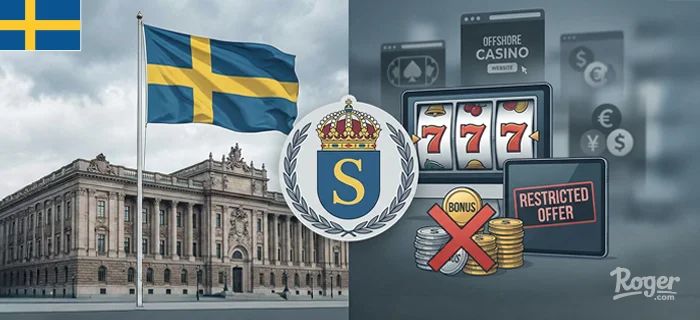
Sweden is considering a total ban on gambling bonuses. Many fear this could benefit the government monopoly and drive players offshore.
⚖️ Heated debates are taking place throughout Sweden over a proposed ban on all casino bonus promotions.
The move has been publicly backed by Svenska Spel and ATG, the operators responsible for the government's monopolistic grip on the market. The plan came to public light when it was printed in Svenska Dagbladet, one of the country's largest newspapers, in early November.
Table of contents
- Sweden's bonus ban
- Opposition mounts to the ban
- Sweden's changing regulatory system
- Combatting offshore operators
Sweden's bonus ban
A ban on all forms of casino bonuses would mean no incentives. Freespins and matched deposits have become a staple of online casinos around the globe and are a way to let new customers try out products. Under the scheme, no licensed Swedish operators would be able to provide them.
Anna Johnson of Svenska Spel and ATG representative Hasse Lord Skarplöth have argued that bonuses can lead to gambling harms. In particular, they highlighted the appeal of these to younger players, which could cause long-term issues and addictions.
Backing this up was the figure that gambling participation of boys in the second year of high school had increased from 27% to 43% in five years, according to a report by the Swedish Association for Alcohol and Drug Education.
📊 Sweden’s shifting bonus regulations are also pushing many consumers to explore alternative platforms.
To better understand the current landscape, many choose to review some of the best casino options for Swedish players, where reputable and fully licensed operators are listed for comparison. This helps players make informed decisions whilst staying within Sweden’s regulated market.
Opposition mounts to the ban
The Swedish Trace Association for Online Gambling (BOS) has come out in opposition to this, also posting its thoughts in the Svenska Dagbladet newspaper. They have said that it would benefit both companies commercially at the cost of poorer consumer protection.
🤔 They believe that it would speed up the process in which Swedish consumers begin to access unlicensed, offshore operators. They accused the two companies of trying to use this to increase their market share.
Gustaf Hoffstedt, Secretary General of BOS, shared the concerns about the increase in gambling figures in younger age groups. However, he voiced concerns that a ban on bonuses would not solve this problem. He stated:
We believe that everyone agrees and is concerned that gambling among young people under the age of 18 is a growing problem, not to claim that this is due to the welcome bonuses that are currently offered to adult players, without mentioning how today’s young people learn to play for money through so-called skins and loot boxes in their favourite games, is not serious.
Sweden's changing regulatory system
The country is currently in the midst of an overhaul of its gambling laws and regulations. This September, a further proposal was put forward that would tighten loopholes which allowed offshore and illegal operators to serve Swedish players. The report was submitted by Marcus Isgren to the Ministry of Finance.
👉🏻 In Sweden, the law currently penalises those who target Swedish players. This can be done not only through targeted advertising but also through Swedish-language customer service helplines and related options. This would see operators fined if they serve Swedish customers, regardless of these other factors.
Hoffstedt claimed that this left many other issues unresolved. Mainly, Swedish people speak other languages, such as English. They can also gamble using Euros. Thus, it would do little to stop their use.
Combatting offshore operators
Offshore gaming operators pose significant challenges to nations worldwide. At their core, these firms operate outside the jurisdiction of any one nation's regulatory scheme. By positioning themselves this way, they are not subject to consumer protections, transparency, safety regulations, and can employ significant unfairness or risk to players.
Yet this characterisation is not universally applicable. Some of the offshore operators are of exceptionally high standards, creating a different kind of problem altogether.
The licensed domestic providers have to compete with them, but the offshore casinos often enjoy lower operating costs due to favorable tax regimes and freedom from regulatory compliance costs.
When consumers patronise these platforms, they're directing expenditure towards them. This represents taxable revenue that could otherwise flow to the country where players reside.
This is the key concern for governments and gambling regulatory bodies: apply too much pressure, and consumers flee offshore; adopt a too permissive approach, and nations risk significant social issues whilst failing to capture sufficient tax revenue.
📜 An illustrative example of this delicate balance is provided by the Netherlands. A rise in the gambling tax is being introduced in two stages, the first of which will see rates increase from 30.5% GGR to 34.2% GGR in January 2025.
This will rise again to 37.8% a year later, in January 2026. Instead of increasing government revenues, an August report indicated it would reduce revenues by €40 million this year. Previous estimates had said the increase would be €100 million.
Consequently, Sweden should make a rather cautious advance since policy interventions of this type can have unexpected consequences. There are, unfortunately, few case studies from jurisdictions that have adopted similar measures. Further research may be required on the potential impact before a full implementation is pursued.